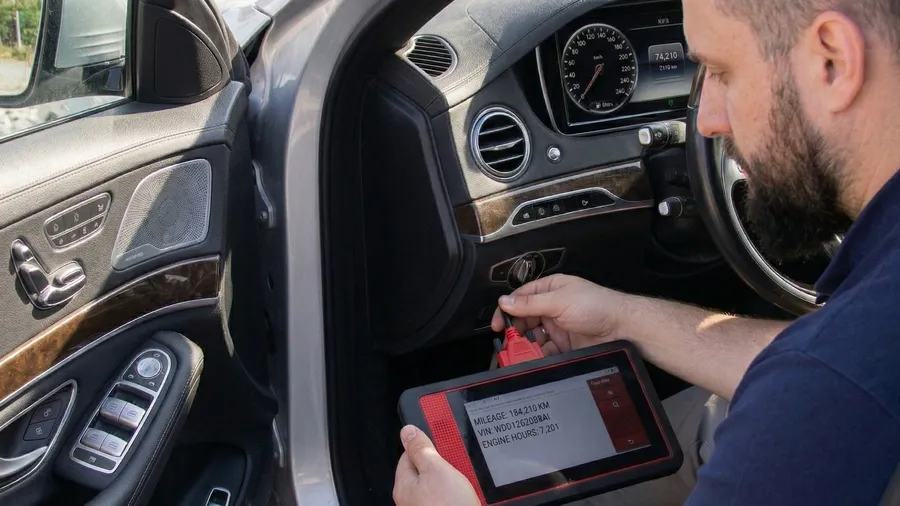
CarSherpa professional diagnostic scanner checking the real electronic mileage of an imported used car in Hungary to prevent odometer rollback scams.

The Import Mileage Scam in Hungary: How to Detect Odometer Fraud on Used Cars

  •  March 30, 2026
  •  Christopher

The "Freshly Imported" Trap: How to Avoid Mileage Scams in Hungary

Browse any Hungarian used car website like Használtautó.hu, and you will see the phrase "Németországból frissen behozott" (Freshly imported from Germany) plastered across thousands of ads.

For expats, an imported car sounds incredibly appealing. Cars from Germany are assumed to be well-maintained on smooth Autobahns, while cars from Italy are famous for having zero winter rust. But buying an imported car in Hungary comes with a massive, hidden risk: the border crossing acts as a magic eraser for the car's history.

Here is exactly how the import mileage scam works in Hungary, the fatal flaw in the government background check system, and how to protect yourself.

Why the Hungarian JSZP Database Cannot Detect Import Mileage Fraud

If you have done your research, you probably know about JSZP (Jármű Szolgáltatási Platform). It is the Hungarian government’s fantastic, free online database where you can enter a license plate and see a car’s MOT history, accident reports, and mileage records.

But JSZP has one fatal flaw: It only starts recording data after the car gets its first Hungarian license plate.

If a dealer buys a taxi in Germany with 450,000 km, drives it across the Hungarian border, and rolls the odometer back to 150,000 km before taking it to the Hungarian MOT station, JSZP will officially record the car as having 150,000 km. The government system inadvertently legalizes the fraud.

How to Check the Real Mileage of an Imported Car in Hungary

If the car does not have a Hungarian license plate yet (or only has temporary "P" or "Z" plates), JSZP is useless to you. You must rely on the Chassis Number (VIN).

To check foreign history, you need to use international, paid databases.

  • AutoDNA / Carfax: These are the gold standard for imported vehicles. For a few thousand Forints, they pull data from European insurance companies, foreign dealerships, and international auction sites.
  • A Warning on CarVertical: While highly marketed, many professionals find their data in Central Europe to be inconsistent compared to AutoDNA. Use it as a secondary tool, not your only source of truth.

Always ask the seller for the VIN before you even go to look at the car. If they refuse to give it to you over the phone or in a message, walk away. They are hiding something.

How to Detect Odometer Fraud Beyond the Dashboard Display

Let’s say the dealer was smart. The car has no international auction history, and the paper service book looks suspiciously brand new. How do you know the mileage is real?

You have to look past the dashboard.

When scammers roll back an odometer, they usually only hack the instrument cluster because it is fast and cheap. However, modern cars store their mileage in multiple deep electronic modules—like the transmission control unit, the ABS module, or the airbag controller. Furthermore, physical wear and tear (the condition of the steering wheel, pedal rubbers, and seat bolsters) rarely lies.

The dashboard shows what the seller wants you to see. The electronic modules show the truth. At CarSherpa, we plug into every car's deep diagnostic systems during our Budapest inspections and cross-reference the electronic mileage data against physical wear — catching the discrepancies that cost buyers hundreds of thousands of Forints.

Related questions

Odometer fraud — rolling back the mileage display — is illegal in Hungary but remains common, particularly on imported vehicles. A car may have covered 400,000 kilometres as a taxi in Germany, only to appear with 130,000 kilometres on the dashboard after crossing the border. The JSZP cannot detect this because it only records from the date of Hungarian registration. Detecting mileage fraud requires cross-referencing the dashboard reading against mileage stored in the car's deep electronic modules (ABS, transmission control unit, airbag controller) — which CarSherpa does as standard during every inspection.

JSZP (Jármű Szolgáltatási Platform) is Hungary's official free online vehicle history database. You can search by licence plate to see a car's recorded MOT history, mileage records, and accident reports. Its critical limitation is that it only begins recording data after a vehicle receives its first Hungarian licence plate. Any history from a car's country of origin — including accidents, mileage, and prior ownership — is completely invisible. For imported vehicles, which make up a large proportion of the Hungarian used car market, this means a "clean" JSZP record can be entirely meaningless.

Every inspection follows a structured 10-section checklist covering: identity and document verification (VIN, registration, service history, glass timestamps); exterior bodywork and forensic paint analysis; wheels, tyres, and brakes; engine bay condition; underbody, chassis, and exhaust; interior and safety systems; full OBD-II electronic diagnostics including forensic fault code analysis; hybrid and EV systems where applicable; test drive dynamics; and the boot and tool kit area. You receive a stamped, signed physical report on the day alongside a complete digital package via Google Drive.

No — but skipping one is one of the most expensive decisions you can make. Used cars in Hungary frequently carry hidden problems: rolled-back odometers, undisclosed accident damage, cleared fault codes, and imported history that the Hungarian government database simply cannot see. A CarSherpa pre-purchase inspection typically costs a fraction of what a single hidden defect costs to repair. It is not a legal requirement. It is financial common sense.

Nepper is Hungarian slang for a used car trader, typically referring to smaller independent dealers operating from gravel-lot sites on the outskirts of cities. Their business model involves buying cheap, high-mileage, or damaged cars from Western Europe, cleaning them up, and selling for profit. The specific risk for expats is the "foreign contract trick" — where a dealer asks you to sign a contract listing the previous German or Italian owner as the seller rather than the dealership. This deliberately strips you of the mandatory 1-year statutory warranty (kellékszavatosság) that Hungarian consumer law provides when buying from a registered business. Always ensure the contract names the Hungarian business as seller, and always demand a bilingual contract.

Buy your next car with confidence