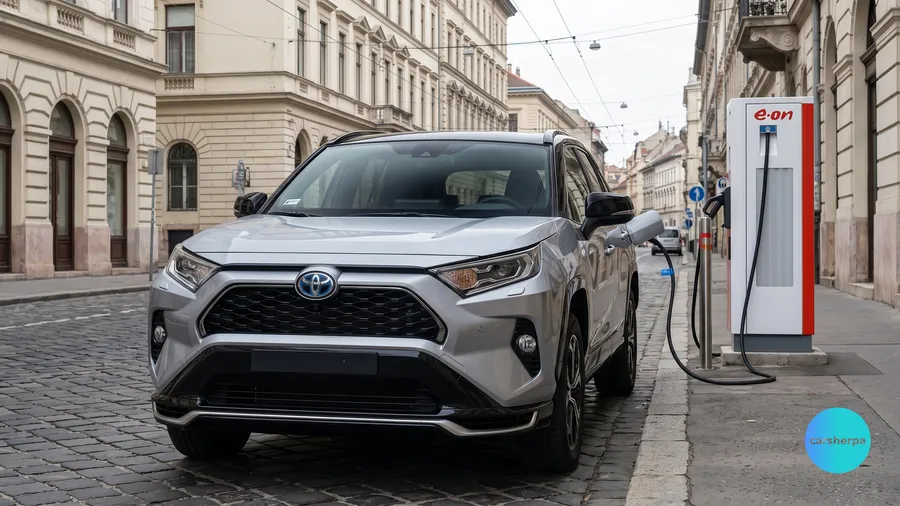
Used hybrid and electric vehicles are increasingly appearing in the Hungarian used car market, driven by Western European EV policy pushing older combustion cars eastward and a growing appetite among Budapest expats for lower running costs. The appeal is genuine — lower fuel costs, reduced road tax, and quieter urban driving.
But buying a used hybrid or EV in Hungary carries a specific set of risks that go well beyond what a standard petrol car buyer encounters. The battery is the elephant in the room — and it is always the most expensive component in the vehicle.
The Hungarian Registration Tax Situation for Hybrid and Electric Cars
Before discussing the technical risks, the administrative picture matters enormously for your total cost calculation.
Hungary's Regisztrációs adó (registration tax) for imported vehicles is calculated on engine type, displacement, age, and emissions rating. The good news for EV buyers is that fully electric vehicles are exempt from registration tax entirely. The less good news is that hybrid vehicles occupy complicated territory.
Plug-in hybrids (PHEV) with a EURO 6 rating and relatively recent age typically attract lower registration tax than equivalent petrol models — often 30,000–80,000 HUF. Standard (non-plug-in) hybrids are assessed like petrol cars of the same displacement, which can be misleading for buyers who assume "hybrid" automatically means reduced tax.
For older hybrid models (pre-2017, particularly pre-EURO 6 generation Prius, early Auris hybrids), the registration tax can be disproportionately high relative to the car's market value. Always calculate the registration tax before committing to purchase — not after.
Road tax (gépjárműadó) is also significantly lower for electric vehicles. Fully electric cars pay a fraction of the rate that equivalent combustion cars pay, which produces meaningful annual savings over years of ownership.
The Battery Question: What You Cannot See From the Listing
A used hybrid or electric car's value — and its future ownership costs — hinges almost entirely on the condition of the high-voltage (HV) battery. This is the component that every seller hopes you won't check carefully and that every professional inspector treats as the primary focus.
Battery degradation is normal and expected. A typical lithium-ion EV battery loses approximately 2–3% of its original capacity per year under normal usage conditions. A 2017 electric car therefore has perhaps 75–80% of its original range remaining in ideal conditions. The questions are: how fast has this specific battery degraded, and are any individual cells within the battery showing abnormal deterioration?
State of Health (SOH) is the metric that expresses battery condition as a percentage of original design capacity. A 2019 Nissan Leaf with 85% SOH has 85% of its original range. The same car with 65% SOH is functionally a much more limited vehicle and approaching the threshold where battery replacement becomes a serious financial consideration.
SOH can be read via OBD-II on many (but not all) hybrid and electric vehicles using specialist diagnostic software. The CarSherpa inspection process reads SOH where the vehicle protocol supports it — and checks individual cell voltage deviation where full SOH data is unavailable, since cell imbalance is often the early warning sign of battery degradation before it appears in headline SOH figures.
For vehicles where neither SOH nor cell data is accessible via OBD, physical symptoms during a test drive become the primary assessment tool: range consistency in different driving modes, regenerative braking engagement quality, any warning lights, and the charge rate behaviour from a known charger.
The Toyota Hybrid Advantage in Hungary
Toyota hybrids — specifically the Prius, Auris Hybrid, C-HR Hybrid, and Corolla Hybrid — occupy a special position in the Hungarian used hybrid market. Toyota's NiMH (nickel-metal hydride) battery chemistry, used in older Prius generations, has a proven longevity record that lithium-ion chemistry in many competitors does not match. High-mileage Prius vehicles (200,000+ km) with original batteries are common in Hungary because the batteries genuinely last.
The risk profile for a used Prius is therefore materially different from that of a used Nissan Leaf or Renault Zoe. Toyota's hybrid system is also simpler in some respects — no external charging required, no charge port to inspect, and a generation of technicians in Hungary who have been working on Prius vehicles for twenty years.
For an expat buying their first hybrid in Hungary without technical confidence in the EV space, a well-maintained Prius or Auris Hybrid is a lower-risk entry point than a first-generation plug-in EV.
What to Check at a Hybrid or Electric Car Viewing
Charging port pins (for PHEV and EV). Inspect the charging port carefully. The pins inside should be clean and free of any burn marks, discolouration, or corrosion. Burn marks indicate electrical arcing — caused by poor connections, incorrect cable use, or charging equipment faults — and can indicate significant issues with the on-board charging system.
Granny cable and Type 2 cable presence. The original charging cables (a standard household 230V cable and the Type 2 fast-charge cable where applicable) should be present and in good condition. Replacement cables cost 30,000–100,000 HUF depending on specification. A seller who has lost the original cables may have lost them because they didn't use the car as a plug-in — which itself may explain higher-than-expected battery degradation.
Inverter coolant reservoir. Hybrids and EVs use a separate cooling circuit for the power electronics (inverter). Check the inverter coolant reservoir level and colour — it should be clear or lightly tinted, not brown or murky. Neglected inverter coolant accelerates degradation of the high-voltage system components.
Regenerative braking test. During a test drive, drive at approximately 50 km/h and lift off the throttle without touching the brake pedal. You should feel a smooth, progressive deceleration as the motor switches to generator mode. Abrupt, jerky, or absent regeneration can indicate issues with the drive motor or its control electronics.
Warning lights. Any hybrid or EV-specific warning light present after engine start — particularly the triangle with exclamation mark (hybrid system warning), battery indicator, or charge system warning — is a serious flag requiring professional investigation before purchase.
The Registration Tax Calculation: Always Run It First
Before viewing any imported hybrid or EV in Hungary, calculate the Regisztrációs adó using the official calculator on the Hungarian National Tax Authority website (nav.gov.hu). The registration tax can vary by tens of thousands of Forints based on the specific model year, engine code, and emissions rating — and this significantly affects whether a given asking price represents genuine value.
A 2015 Prius that looks attractively priced at 2,800,000 HUF may carry a registration tax of 60,000–90,000 HUF on top. A 2018 Nissan Leaf at 4,500,000 HUF carries zero registration tax. Factor this into your total purchase cost before you negotiate.
Viewing a hybrid or electric car in Budapest and unsure about the battery health or registration costs? CarSherpa's Sherpa Report includes a full EV/hybrid systems assessment — we check everything the seller hopes you don't. Book now!