Not every car viewing needs a professional inspector. Some cars announce their problems immediately — before you've even opened a door. This checklist gives you a practical framework for what a non-technical buyer can check themselves, what the warning signs look like, and when to walk away before spending money on a full inspection.
None of this replaces a professional pre-purchase inspection. It reduces the number of bad cars you spend time on before you find one worth inspecting properly.
Before You Arrive: What to Check Remotely
Get the VIN and run it. Before you travel anywhere, ask the seller for the 17-character VIN (Alvázszám). Run it through the free JSZP database and an international check via AutoDNA or CARFAX if the car is imported. A seller who refuses to share the VIN before a viewing is hiding something. This is not negotiable.
Check the MOT expiry date. The JSZP shows the current Műszaki vizsga status. If the MOT expires within the next three months, budget for renewal costs (typically 12,000–20,000 HUF plus any repair work needed to pass).
Check the listing date. A car that has been listed for more than 60 days in Hungary's active used car market usually has something wrong with it — the price is too high, there's a known fault, or the car has failed previous buyers' inspections. Ask why it hasn't sold.
At the Car: What to Check Before Starting the Engine
Panel gaps. Stand back and look along the side of the car from a low angle. The gaps between panels — bonnet to wing, door to door, door to sill — should be even and consistent. Uneven gaps indicate accident repair where panels were removed and not perfectly realigned.
Paint colour consistency. In daylight, look along each panel for colour variation. A professional respray of a single panel is almost always slightly different from the factory-applied paint on adjacent panels. This is easier to see in direct sunlight at a slight angle.
Tyre brand matching. Look at the tyres on each axle. Matched brands per axle is standard practice. Mixed brands — one Michelin and one Nokian on the same axle, for example — suggest unplanned tyre replacements and an owner who replaced one when it failed rather than pairs, which is a mild indicator of how they maintained the car overall.
Tyre age from the DOT code. On the outer sidewall of every tyre you'll find a four-digit code — the last four digits of the DOT number. The first two are the week of manufacture, the last two are the year. 3519 means week 35 of 2019. Tyres older than six years should be budgeted for replacement regardless of tread depth, as rubber degrades with age even on low-mileage cars.
Boot floor lift. Open the boot and lift the boot floor or carpet. Look at the spare wheel well and the metal around it. Fresh underseal applied in patches, rippled metal, or visible welding seams that don't look factory-finished indicate rear-end accident repair. This is one of the most reliable hidden clues available without tools.
Door gaps and hinge alignment. Open every door fully and check that each one swings cleanly on its hinges without sagging. A door that drops when fully open, or that doesn't sit flush when closed, indicates either hinge wear or bodywork repair.
Starting the Engine: What to Listen For
Always insist on a cold start. Arrive early enough that the engine has not been running. A pre-warmed engine hides the most informative startup sounds. If you arrive and the engine is already warm, this is a deliberate move by the seller to conceal cold-start issues. You can request to return another time for a cold start, and if the seller refuses, that tells you something.
Listen for chain rattle on startup. A brief metallic rattling sound in the first two or three seconds after a cold start, coming from the top of the engine, indicates timing chain stretch — one of the more expensive engine repairs, costing 150,000–400,000 HUF depending on the model.
Watch the exhaust on startup. A brief puff of white smoke on startup is usually harmless condensation. Blue smoke is oil burning — indicating piston ring or valve seal wear. Black smoke is excess fuel and indicates injection or sensor problems. Persistent white smoke after the engine has warmed up indicates coolant entering the combustion chamber, which points to a head gasket fault.
Check the oil level and condition. With the engine cold, pull the dipstick. Oil should be amber to brown — not black sludge, not milky (milky oil indicates water contamination from a head gasket fault), and certainly not smelling of fuel (which indicates injector leaks allowing fuel into the oil). The level should be between the minimum and maximum marks.
Interior: What to Check Without Tools
Lift the carpets. Pull back the carpet in the footwells and boot. Look and feel for dampness. A damp floor means either a leaking heater matrix, a faulty door seal, or — more seriously — flood damage. Flood damage is increasingly common on cars imported from regions affected by severe weather.
Mileage vs wear check. Sit in the driver's seat and look at the steering wheel rim, the gear lever knob or selector surround, the driver's door card armrest, and the pedal rubbers. These components wear in direct proportion to actual use. A car claiming 80,000 km with a heavily worn steering wheel and polished-through pedal rubbers has been used significantly more than that.
Check all the electrics. Turn the ignition to position two (without starting the engine) and verify that all dashboard warning lights illuminate — then go out when you start the car. Any light that stays on after startup is a live fault. Test every electric window, both door mirrors, the infotainment system, the air conditioning (it should blow genuinely cold within 30 seconds), and any sunroof.
Seatbelt label dates. Pull out the seatbelt webbing and look at the fabric label sewn into the belt near the buckle end. It shows a manufacture date. On a genuine unrepaired car, the seatbelt dates should match the vehicle's production year. Mismatched dates — particularly a belt dated after the car's registration year — indicate airbag deployment and replacement following an accident.
When to Stop and Call a Professional
If the car passes your basic checks — no obvious paint inconsistency, clean oil, honest cold start, matching seatbelt dates, dry carpets, even panel gaps — it is worth taking to the next level. This is when you book a professional pre-purchase inspection.
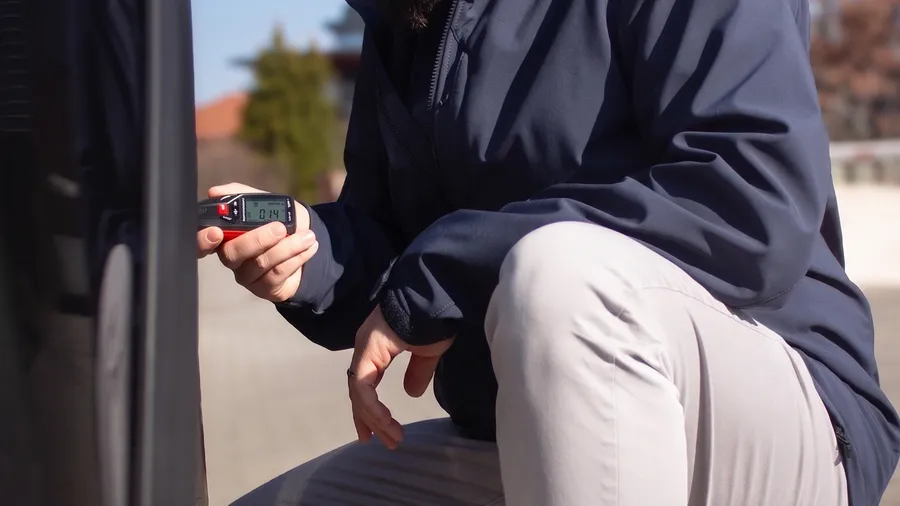
A professional inspection adds what you cannot do without tools: forensic paint thickness measurement on all panels (catching repainted panels that look perfect to the eye), full OBD-II multi-system diagnostic scan (reading fault codes from the engine, transmission, ABS, and airbag modules), underbody structural assessment, coolant block test for head gasket integrity, and an international database cross-check.
The checklist above filters out the obviously bad ones. CarSherpa finds the problems in the ones that look fine.
Found a car that passes the visual check? That's when it gets interesting. Book a Sherpa Check or Sherpa Report and find out what's underneath. Book your inspection now!