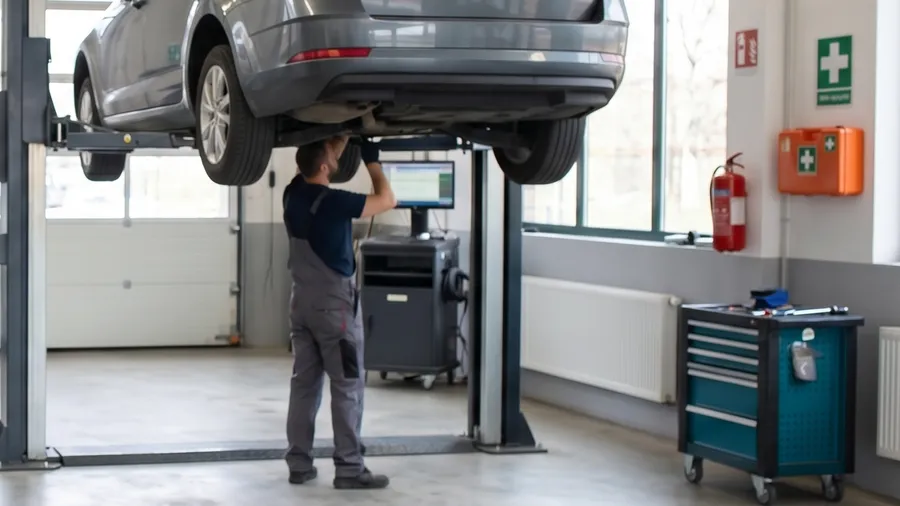
The Hungarian Műszaki vizsga — the mandatory two-yearly roadworthiness test equivalent to the UK MOT or German TÜV — is one of those administrative hurdles that expats encounter without much preparation. When a car passes, nothing much happens. When it fails, the situation becomes suddenly stressful, particularly if you don't speak Hungarian and don't know the testing station staff.
This guide explains exactly what the Hungarian MOT tests, what triggers a fail, what your legal obligations are when it fails, and how to navigate the re-test process without a Hungarian speaker by your side.
What Does the Hungarian Műszaki Vizsga Actually Test?
The inspection is managed by authorised testing stations (Műszaki vizsgaállomás) licensed by the National Transport Authority (Nemzeti Közlekedési Hatóság). The test covers the following areas:
Brakes — brake force and balance measured on a roller brake tester. Both front and rear brakes are assessed individually. Imbalanced braking — where one side produces significantly less force than the other — is a common fail cause and usually indicates a seized calliper or worn brake pad on one side.
Suspension and steering — shock absorbers, ball joints, tie rod ends, and wheel bearings are assessed for play and condition. Worn suspension components are one of the most frequent causes of failure, particularly on high-mileage imported cars.
Emissions — exhaust gas content is measured for both petrol and diesel vehicles. A car with a clogged catalytic converter or EGR system, or one that has had the DPF removed, will fail emissions even if everything else is in order.
Lights — all external lights are tested for function, alignment, and lens condition. Cracked headlight lenses or misaligned beams can cause a fail.
Tyres — minimum tread depth, damage, and correct size for the vehicle. Mismatched tyre sizes on the same axle can trigger a fail.
Windscreen — chips and cracks within the driver's direct field of vision are a fail cause. Minor chips outside the central vision zone may pass at the inspector's discretion.
Bodywork — structural corrosion at jacking points, sill sections, and chassis rails. Cosmetic rust is generally acceptable; rust that has penetrated the structural sections is not.
Safety equipment — functioning seatbelts for all positions, warning triangle, first aid kit, and reflective vest must be present.
What Happens Immediately When a Car Fails
If the inspector identifies faults that prevent a pass, they issue a failure notice detailing each specific defect. The registration document (Forgalmi engedély) is stamped with the fail notation. You can legally drive the car home from the testing station but must not continue using it on public roads until the faults are repaired and the car passes re-test.
Driving a car with an expired or failed MOT in Hungary is illegal and carries significant penalties including immediate seizure of the registration document by police if stopped.
The Re-Test Process: What You Need to Do
Step 1 — Arrange repairs. Have the specific faults identified in the failure notice repaired by a garage. You do not have to use the testing station's affiliated garage — you can take the car anywhere. Get an invoice for every repair carried out, as the inspector may check that the specific fault has been addressed.
Step 2 — Return for re-test. The re-test must address the specific items listed in the fail notice. In Hungary, if the re-test is conducted within a set timeframe at the same station (typically noted on the failure document), only the failed items are re-tested, not the full inspection. If you exceed this window, a full re-inspection fee applies.
Step 3 — Pay the re-test fee. The MOT fee is non-refundable if the car fails — you pay again for the re-test. Standard passenger car MOT fees run approximately 12,000–16,000 HUF for the official test. If the testing station charges a pre-inspection preparation fee separately, this is additional.
When You Are Buying a Car with a Failed or Expiring MOT
This situation comes up frequently in used car purchases. A seller may offer a reduced price on a car with an upcoming MOT due, presenting it as a cost saving. It can be — but only if you know exactly what needs fixing to pass.
An MOT that is due in one month is not necessarily a problem. An MOT that is due in one month on a car with worn brake discs, cracked CV boots, and emissions issues is a different conversation entirely — and the repair costs to bring it to a passable standard could easily exceed 200,000–300,000 HUF.
This is exactly why CarSherpa assesses MOT risk during every pre-purchase inspection. We identify the specific items likely to cause a fail and estimate the cost to rectify them — so you know whether the reduced asking price actually represents a saving or simply transfers the seller's MOT problem onto you.
How the Timing Affects Your Car Purchase
If you buy a car and the MOT expires before you complete registration at the Kormányablak, you are in a difficult position. An expired MOT does not invalidate a car purchase, but you cannot legally drive the unregistered vehicle to a testing station on public roads. You would need to arrange transport.
For newly imported cars, the MOT situation is different again — if the car has a valid EU MOT from its country of origin, a simplified Hungarian MOT "nationalisation" (honosítás) procedure costing 8,000 HUF converts it to a Hungarian stamp. If the foreign MOT has expired, a full Hungarian MOT at approximately 16,000 HUF is required before registration.