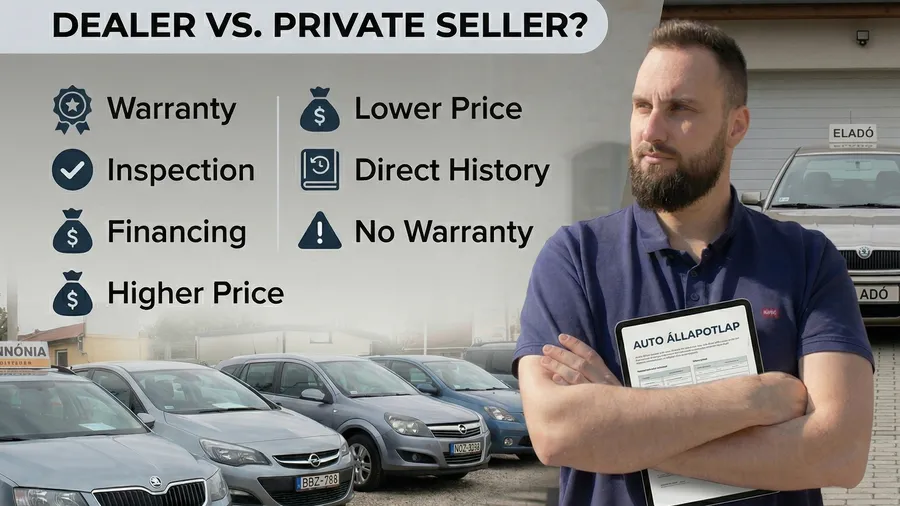
If you spend more than five minutes researching the used car market in Hungary, you will inevitably encounter the word "Nepper." It is a Hungarian slang term for a used car dealer, and it often carries a heavy, negative connotation. For expats trying to navigate the market, the difference between buying from a private local owner and a "murvás neppertelep" (a gravel-lot dealership) is the difference between a reliable daily driver and a financial nightmare.
Here is the no-nonsense guide to understanding the Hungarian used car ecosystem, and how to protect yourself no matter who you buy from.
What Is a Nepper? Understanding Hungarian Used Car Dealers
Traditionally, a "Nepper" is a car trader. While there are plenty of honest, large-scale used car dealerships in Budapest, the term usually refers to the smaller, independent lots—often literally just a fenced-in gravel lot (murvás telep) on the outskirts of the city.
Their business model is simple: They buy cheap, high-mileage, or slightly damaged cars from Western Europe (Germany, Austria, Italy), bring them to Hungary, clean them up, polish the paint, and sell them for a profit.
Buying from a Hungarian Used Car Dealership: Rights, Risks and Red Flags
- The Pros: Convenience. A good dealership will handle all the nightmare paperwork for you, including the Origin Check (Eredetiségvizsgálat), the MOT (Műszaki vizsga), and the registration. Furthermore, Hungarian law dictates that businesses must provide a 1-year statutory warranty (kellékszavatosság) on hidden defects to private buyers.
- The Cons: Hidden history. Freshly imported cars are completely invisible to the Hungarian government's free JSZP background check system. Dealers are also experts at "putting lipstick on a pig"—cleaning the engine bay to hide oil leaks or clearing error codes with a cheap scanner just before you arrive.
Buying from a Private Seller in Hungary: Is It Actually Safer?
Buying a car from the actual Hungarian owner who drove it daily can often be the safest route, but it comes with its own rules.
- The Pros: You can often trace the real history of the car. You get to meet the person who drove it, see how they treat their property, and check the Hungarian service history. There is also usually more room to negotiate the price.
- The Cons: You are entirely on your own for the paperwork. More importantly, there is no statutory warranty. Private sales are strictly "sold as seen." If the transmission explodes on your drive home, the seller has no legal obligation to refund you.
3 Red Flags That Mean You Should Walk Away from a Hungarian Car Dealer
If you decide to visit a gravel-lot dealership, keep your guard up. Walk away immediately if you spot any of these three tricks:
- The "Warmed-Up" Engine: If you arrive to test drive a car and the engine block is already warm to the touch, be highly suspicious. Cold starts reveal the most expensive mechanical problems, like failing timing chains or worn injectors.
- The "Foreign Contract" Trick: This is the most common scam used on expats. To avoid giving you the mandatory 1-year statutory warranty, the dealer will ask you to sign a sales contract that lists the previous German/Italian owner as the seller, not the Hungarian dealership. Never sign this. You are legally waiving your rights.
- "Megtekintett Állapotban" (In Viewed Condition): If you are buying from a dealer, do not let them sneak this phrase into a Hungarian-only contract. Always demand a bilingual contract (Kétnyelvű adásvételi szerződés) so you know exactly what legal rights you are signing away.
The Only Thing That Actually Protects You: An Independent Car Inspection in Budapest
Whether the seller is a smiling local family or a fast-talking dealer on a gravel lot, the only thing that matters is the mechanical reality of the vehicle.
Whether the seller is a polished dealership or a private individual in a car park, the mechanical reality of the vehicle is the only thing that protects your money. CarSherpa travels to the seller anywhere in Budapest, inspects the car with professional diagnostic tools, and gives you a clear written verdict before you sign anything.